
SEO for SaaS: The Framework We Actually Use
Every SaaS founder we talk to tells roughly the same story. They hired someone to do SEO. They got a spreadsheet with four hundred keywords on it. Twelve blog posts about productivity tips went out. Eight months later organic is still five percent of signups, the posts rank perfectly well, and nobody converts. Then comes the conclusion, which is where it goes wrong: SEO doesn't work for us.
It almost always does. What's broken isn't the channel, it's the mapping. The traffic you want already exists and somebody is already getting it. The question is whether the page it lands on has anything at all to do with the product you sell. What follows is the framework we run with SaaS clients, in the order we run it. It isn't clever, and I'd be suspicious of anyone selling you clever. It's the version that survives contact with a real roadmap and a real content budget.
Why most SaaS SEO stalls at month three
Months one and two feel great. You publish, Search Console starts reporting impressions, somebody drops a screenshot of a graph going up into the marketing channel. Then month three lands and the clicks flatten out, because the pages that ranked were the easy ones. Broad, informational, and completely disconnected from your pricing page.
The failure happened upstream of the writing, which is why writing more doesn't fix it. A keyword list sorted by volume will always push you toward the top of the funnel, because that's where volume lives. What the list won't tell you is that the term doing 90 searches a month, the one describing the exact job your software does, is worth considerably more than the 12,000-a-month term about the industry your software sits inside.
Volume tells you how many people are searching. It tells you nothing about whether they can buy.
Step 1: map the three searches, not four hundred keywords
Before a person pays for software they run three searches, usually weeks apart and often without noticing they've moved between them. Every page we plan gets mapped onto one of the three.
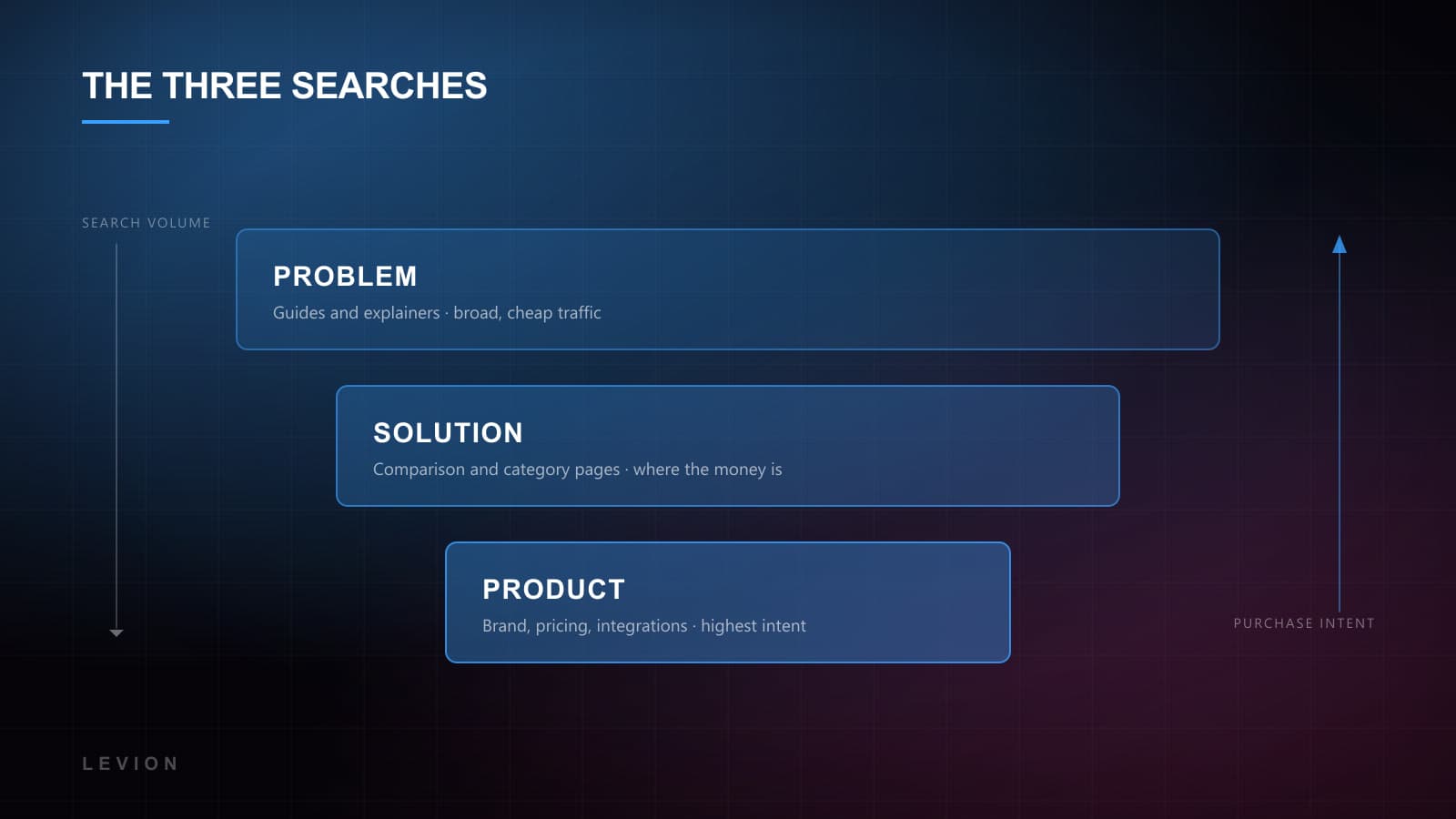
- 01The problem search. They know something hurts, they don't know what to buy. Why is our onboarding drop-off so high. This wants a guide, and honestly it's the least valuable of the three bands.
- 02The solution search. They now know a category exists. Customer onboarding software. Alternatives to X. X vs Y. Comparison and category pages, and this is where the money is.
- 03The product search. They know your name. Brand terms, integration pages, X pricing. Tiny volume, absurd conversion rates, and almost universally under-built because it doesn't look impressive in a report.
Then comes the uncomfortable part. We cut. If a keyword can't be traced to a page that plausibly ends in a trial signup, it doesn't go in the plan this quarter. A shortlist of thirty terms you can genuinely own will beat four hundred you'll never get round to touching, and it has the useful side effect of making the plan fit in someone's head.
Step 2: build the page that ends the search
For each term, ask what would need to be on the page for the reader to stop looking. Not what the word count of the current number one is. What ends the search.
Usually it's the thing everybody else deliberately left out. Real pricing instead of contact us for a quote. The migration path off the incumbent, written honestly, including the parts that are annoying. A screenshot of the actual interface rather than a stylised illustration of a dashboard that doesn't exist. When we ran the search programme for Homevested, a Valencia property brand, the pages that moved were the boring specific ones. 18k impressions, 1.14k clicks, a 6.3% CTR. That CTR is the number worth staring at, because 6.3% means the title matched what the person actually wanted rather than what we hoped they wanted.
- One page per search, not one page per keyword variant. Variants are the same search wearing a different hat.
- Answer the question in the first hundred words. Nobody is scrolling to find out whether you're going to answer it.
- Include the thing your competitor is hiding. Price, limits, who it isn't for. Being the only honest page on a query is a ranking strategy.
- Link down toward the product, not sideways to another blog post. Sideways links feel productive and go nowhere.
Step 3: wire the product into the content
This is the step that separates SaaS SEO from blogging, and it's the one most often skipped. Every page needs a route into the product that makes sense at that stage of awareness. A problem-stage guide ending with start your free trial is proposing marriage on a first date. It should end at the comparison page. The comparison page ends at pricing. Pricing ends at signup. Each handoff is small enough that the reader doesn't feel handled.
We map this as a literal chain before a word gets written, which solves internal linking almost as a side effect. Every new page has to be able to name its parent and its child. If it can't name either, that's usually a sign it shouldn't exist, and it's much cheaper to discover that in a spreadsheet than after somebody has written it.
Step 4: make the technical base boring
None of the above works on a site Google struggles to crawl. The technical layer isn't glamorous and it doesn't need to be clever. It needs to be dull and correct. Fast pages, one canonical per URL, a sitemap that's genuinely accurate rather than generated once in 2023, structured data that says plainly what each page is, and an architecture where nothing important sits more than two clicks from the homepage.
Two things punish SaaS sites specifically. The first is the app subdomain leaking into the index, which means thousands of thin gated URLs quietly eating crawl budget that should be going to your comparison pages. The second is a marketing site rendered entirely client-side, so the crawler receives an empty shell and forms its opinion from that. Both are about a day of work. Both are the difference between publishing and being read. There's more in our SEO service, but the short version is to fix the house before you furnish it.
Technical SEO isn't where you win. It's where you stop losing by default.
Step 5: measure signups, not positions
Average position is the most comforting useless metric in the discipline. It moves, it goes up when you publish, and it has almost no relationship to revenue. We instrument three numbers instead, and we look at them monthly rather than weekly, because organic is far too noisy at weekly resolution to mean anything at all.

- Qualified organic sessions. Traffic on pages inside the mapped chain, with the noise stripped out.
- Organic trial starts, attributed to landing page rather than last click. Last click will credit your brand terms for work the comparison page did.
- Assisted revenue. Deals that touched an organic page anywhere in the journey. This number is always bigger than the last-click one, occasionally by a factor of three.
Watch those three across three quarters and you'll get an honest answer about whether search is working for you. Watch rankings weekly and what you'll mostly get is an anxiety disorder and a series of premature decisions.
The authority problem, and what to actually do about it
Here's what the framework above doesn't solve on its own. If your domain is two years old with eleven referring domains, you can build a genuinely perfect comparison page and still sit on page four, because the incumbents have a decade of accumulated links and you have one launch post on Product Hunt.
The standard advice at this point is to do link building, which in practice means paying someone to write guest posts nobody reads on sites nobody visits. That isn't a strategy, it's a tax with a nicer name. Three things genuinely work for SaaS companies, and all three come out of the product rather than out of an outreach spreadsheet.
- Publish something only you could publish. You're sitting on aggregate data about how your customers behave. An annual benchmark, anonymised and honest and with a methodology section, earns links for years and cannot be copied by a competitor with a bigger content team, because they don't have your data.
- Build a small free tool. A calculator, a checker, a converter that solves one narrow thing in about ten seconds. Tools get linked because they're useful, which is a much more reliable mechanism than asking nicely.
- Use your integrations. Every platform you integrate with has a directory, a partner page and usually a blog that will happily cover a new integration. These are the easiest relevant links a SaaS company will ever get and most companies simply never claim them.
In the meantime, go narrower than feels comfortable. The term with 90 searches a month and a difficulty score of 8 is winnable this quarter. The one with 12,000 and a score of 62 is a two-year project you'll quietly abandon in month five. Win the small ones, stack them up, and the big ones stop being impossible. That's the entire mechanism behind the word authority, with the mystique removed.
What the first six months actually look like
Months one and two: technical cleanup, the keyword-to-page map, and the first three comparison pages. Barely any movement in traffic, which you should expect and warn people about in advance. Months three and four: publish the rest of the solution-stage set, fix internal linking, and start earning links to the two or three pages that deserve them. Impressions will move well before clicks do. That's normal, and it's the earliest honest signal you're going to get.
Months five and six is usually where the shape changes. Not because anything new happened that month, but because the pages published back in month two have finally aged into their rankings. That lag is the single most expensive thing about SEO, and it's also exactly why it compounds: the work carries on paying long after you stop paying for it.
One thing to avoid throughout, because it's the most common way this goes wrong. Don't build your plan by reverse-engineering a competitor's blog. Their content reflects their funnel, their pricing and their sales motion, and you can see none of those three. Copy the output without the reasoning and you get a blog that ranks beautifully for terms that convert for somebody else.
None of this is a secret. It's just unfashionable: fewer pages, more specific, wired into the product, measured on the right line. If you'd rather not run it in-house, that's the programme we run. Either way, cut the keyword list before you write anything. That's the step that changes the outcome, and it's free.