
When a Website Redesign Is Worth It (And When It Isn't)
The conversation always starts the same way. Somebody on the leadership team looked at a competitor's site, came back to their own, and felt something. Usually embarrassment. And a week later the brief arrives: we need a redesign.
Sometimes that's exactly right. Just as often it's a very expensive way to solve a problem that a fortnight of focused work would have fixed for a tenth of the money. We've built both, full rebuilds and surgical repairs, and the honest version is that the deciding factor is almost never how the site looks. It's usually something duller and more measurable.
“It looks dated” is a symptom, not a diagnosis
Sites don't underperform because they're ugly. They underperform because something in the chain from search result to enquiry is broken, and ugliness is just the most visible thing to point at. A beautiful site with a four-second load and no obvious next step will lose to a plain one that's fast and clear. Every time, without much of a contest.
So before anyone opens Figma we look at four numbers: where the traffic comes from, where it leaves, what the top ten landing pages actually do, and how long the thing takes to load on a mid-range phone over 4G. About half the redesign briefs we get dissolve at that point into something much smaller and much cheaper, which is an awkward conversation to have and a considerably better outcome for the client.
A redesign is the most expensive way to test a hypothesis. Make sure you've actually got one first.
Five signals that genuinely justify a rebuild
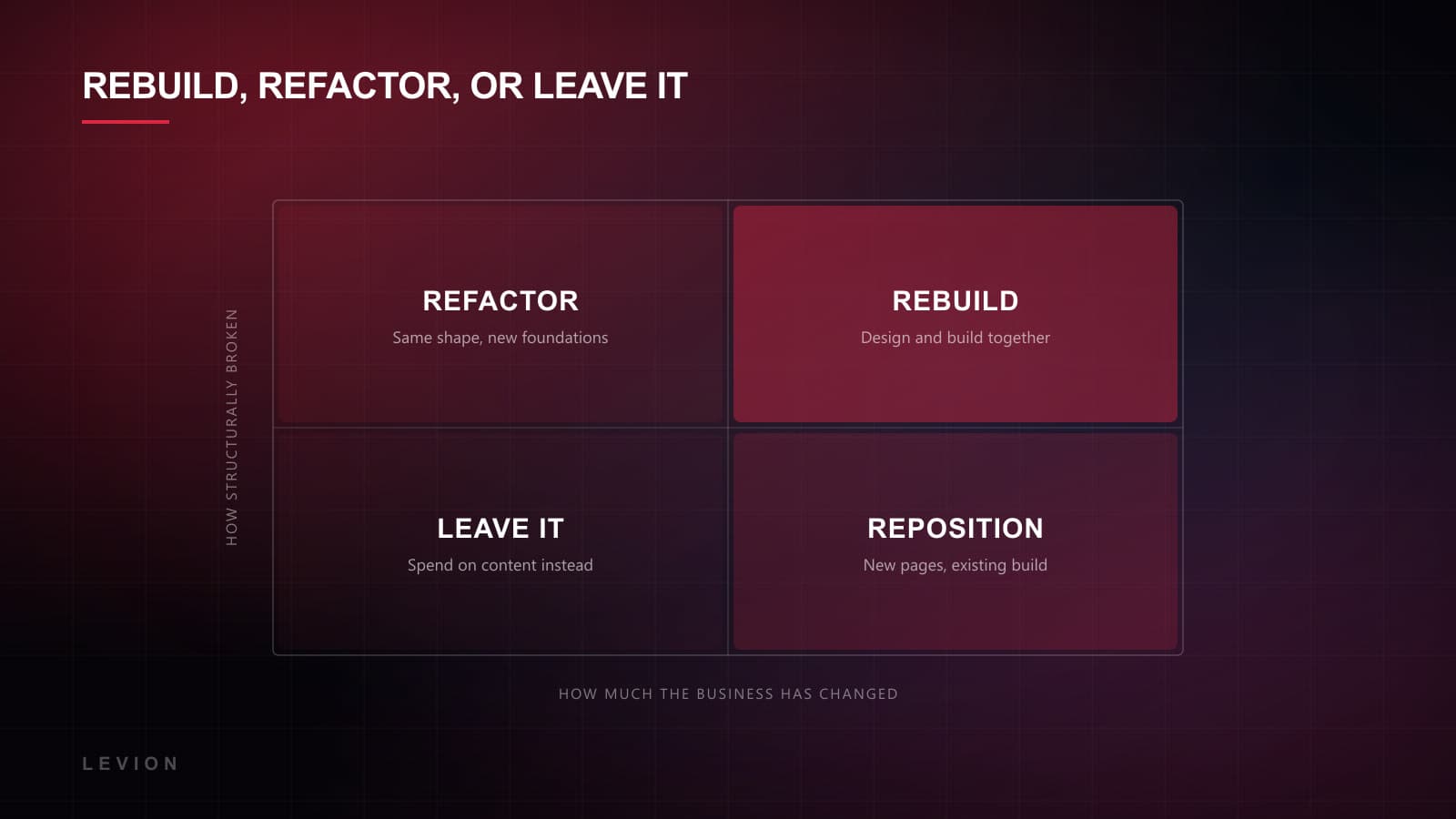
- 01The business changed and the site didn't. You sell to enterprise now, and the site still talks to freelancers. No amount of restyling fixes an information architecture built for a different customer.
- 02The stack is fighting you. Every content change needs a developer, the page builder emits 400KB of CSS, and nobody will touch the theme because the last person who tried broke checkout on a Friday.
- 03Performance is structural. If Core Web Vitals fail because of how the thing is built, with render-blocking bundles and an uncompressed hero video and twelve tracking scripts in the head, you aren't patching that. You're rebuilding it.
- 04The brand is genuinely inconsistent. Four shades of the same blue, three button styles, a logo that exists in six versions. That's a failure of system rather than taste, and it usually needs design and build moving together to fix.
- 05Search can't reach half the site. Client-rendered content, no sitemap, orphan pages nothing links to. We've opened Search Console on sites where Google had crawled three URLs out of twenty-two. Ever, not this month.
Notice what isn't on that list. Our competitor launched something nice. That's a reason to go and look at it, not a reason to spend two months of budget.
Four cheaper things that usually beat a redesign
If none of the five apply, the money is nearly always better spent on one of these. They're much less exciting to talk about. They also tend to move the number faster, which is the only thing that should matter.
- Rewrite the top five pages. Same design, sharper copy, one clear action per page. It's the cheapest lever in existence and almost nobody pulls it first.
- Fix the conversion path. Shorter form, visible pricing, a booking flow that doesn't take three clicks to find. When we did exactly this for Integrity 1st Auto Care it was worth +44% on quote requests.
- Run a performance sprint. Compress the images, remove the scripts nobody remembers adding, lazy-load below the fold. Two weeks, no visual change, measurably faster.
- Build the pages you're missing. Most sites don't need a redesign. They need the six service pages and three case studies that never got written.
Total rebuild, or piece by piece?
If a rebuild is justified, the next question is whether to do it all in one go. Big-bang launches are satisfying and genuinely risky. Everything changes on a single day, so if conversion drops afterwards you have no way of telling which of the two hundred changes did it, and you end up guessing in a meeting.
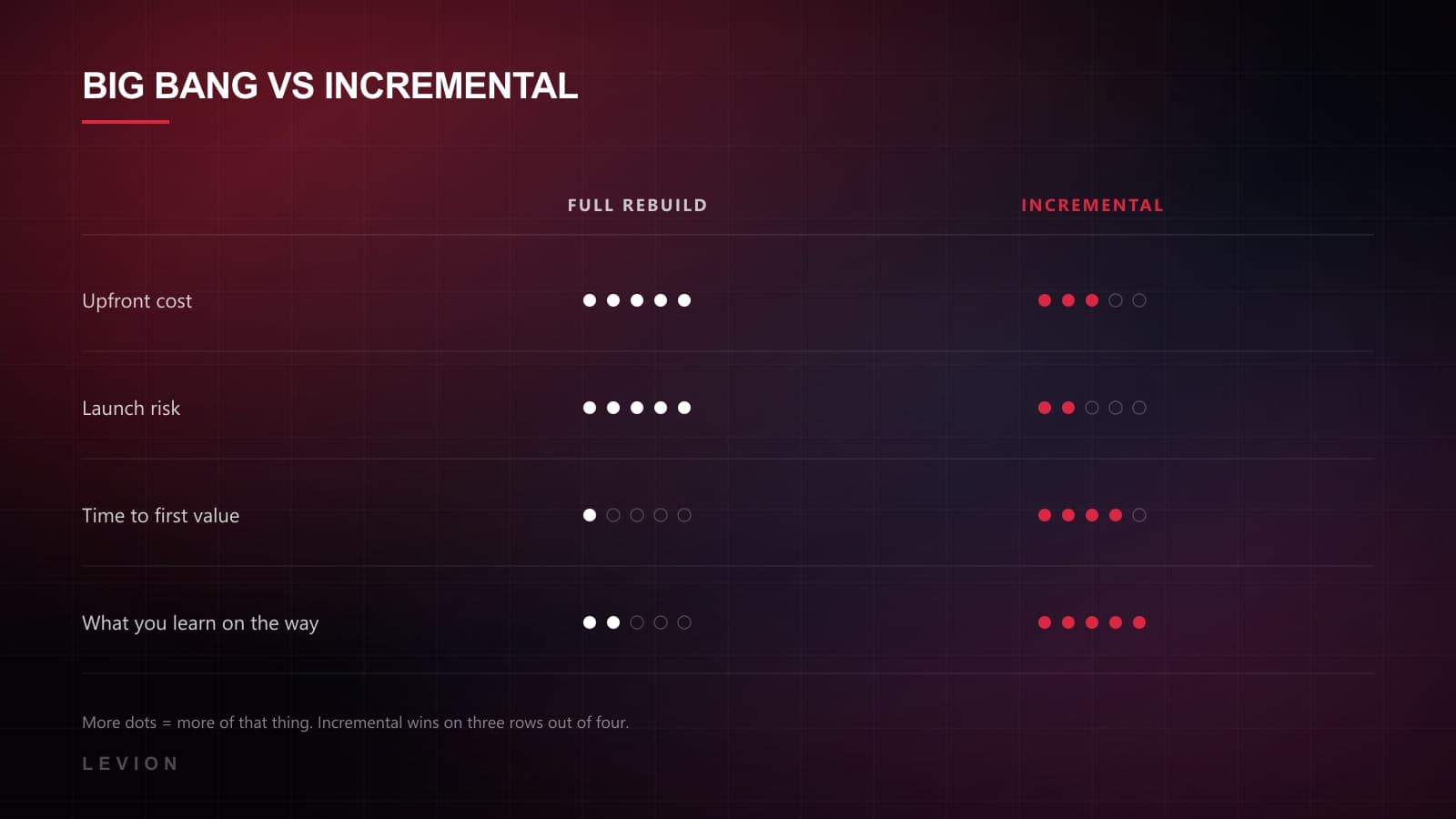
We lean incremental whenever there's meaningful organic traffic to protect. Rebuild the template system first, migrate the highest-value pages, measure what happened, then keep going. The old site keeps running underneath while the new one grows through it. It looks slower on a Gantt chart and it's dramatically less likely to end in a bad quarter, which is a trade most people take once it's put that way.
Big-bang makes sense in two situations. Either the current site is small enough that there's nothing much to lose, or the brand itself is changing and a half-migrated identity would look worse than either version did on its own. For CO4 Workspaces the brand and the site moved together for exactly that reason: the positioning shifted, so a partial rollout would have been incoherent. That launch was worth +38% on tour requests.
How not to lose your rankings on the way
This is the part that gets skipped, and it's the part that turns a perfectly good redesign into a six-month recovery project. The rules are unglamorous and none of them are negotiable.
- 01Crawl the old site before you touch anything. Every URL, every title, every inbound link. You cannot map what you never recorded, and once it's gone it's gone.
- 02301 every old URL onto the page that now does its job. Not the homepage. A mass redirect to the root reads as a soft 404 and the equity evaporates.
- 03Keep the content that ranks. If one page brings 40% of your organic traffic, the new version needs the same substance, even when the layout changes completely.
- 04Ship the technical layer on day one. Canonicals, sitemap, structured data, and hreflang if you run two languages. Not in the follow-up sprint.
- 05Watch Search Console daily for a month. A dip in week two is normal. A dip that hasn't recovered by week six is a redirect map you got wrong.
The four numbers, and how to read them
I mentioned four numbers at the top, so here they are properly. Each one points at a different fix, and the whole exercise takes about an hour with Search Console and analytics open side by side.
- Where the traffic comes from. If 80% is direct and paid, you don't have a design problem, you have a distribution problem, and a redesign will not touch it. If organic is meaningful, protect it obsessively.
- Where it leaves. Find the page with the highest exit rate that isn't a thank-you page. Nine times out of ten it's pricing, contact, or a service page that never says what the service costs.
- What the top ten landing pages do. Not what you think they do. Most companies find that the page bringing a third of their traffic is one nobody has looked at in two years.
- Load time on a mid-range Android over 4G. Not your MacBook on office wifi. This one number explains more lost enquiries than every design decision on the site put together.
Run those four and you'll frequently discover the redesign brief was really a brief for two new pages, a form change and a performance sprint. That's a good outcome, not a disappointing one. It's cheaper and faster, and you can always rebuild next year with considerably better information than you have today.
What to keep from the site you already have
Even when a rebuild is clearly right, treating the old site as worthless is a mistake. There's usually more worth salvaging than anyone expects, and knowing what to keep is honestly half of what makes a migration safe rather than exciting.
Keep the URL structure wherever it still makes sense, because every URL you change is a redirect you have to maintain and a small risk you've chosen to take. Keep the pages that rank, in substance if not in layout. And keep any component the team genuinely uses. If marketing has been assembling landing pages out of the same three blocks for two years, those three blocks are your real design system, whatever the brand guidelines happen to say about it.
Keep the copy that converts, too. There's a strong pull toward rewriting everything because the new design deserves new words, but a headline that's been quietly pulling in enquiries for eighteen months has earned its place. Rewrite it later if you want, deliberately, as a change of its own, so you can actually tell whether it helped or not.
What it costs, honestly
A focused marketing site of eight to twelve pages, custom designed and built properly, is typically six to ten weeks. Add a CMS the team can genuinely use without asking a developer and you're closer to twelve. Anything quoted at three weeks is either a template with your logo on it or a project that will need doing again next year.
The number that matters isn't the invoice, though, and this is where the conversation usually gets stuck. It's the cost of the site you already have: the enquiries it fails to capture, the hours your team burns fighting the CMS, the search traffic that never arrives at all. Put a figure on that, compare the two, and the decision tends to make itself without much argument.
One organisational note, because it decides more redesigns than any spreadsheet does. Whoever owns the number the site is meant to move, whether that's enquiries or bookings or trials, should own the decision. When a redesign is driven instead by whoever is most embarrassed by the current site, the brief quietly becomes make it look modern, and you get a site that photographs beautifully and performs exactly like the last one.
If you want a second opinion before committing to anything, we're happy to run the four-number check and tell you honestly which of the two you need. Sometimes it really is a redesign, and this is what that looks like. Often it's the fortnight of work instead, and we'll say so even though it's the smaller invoice.